



Overview
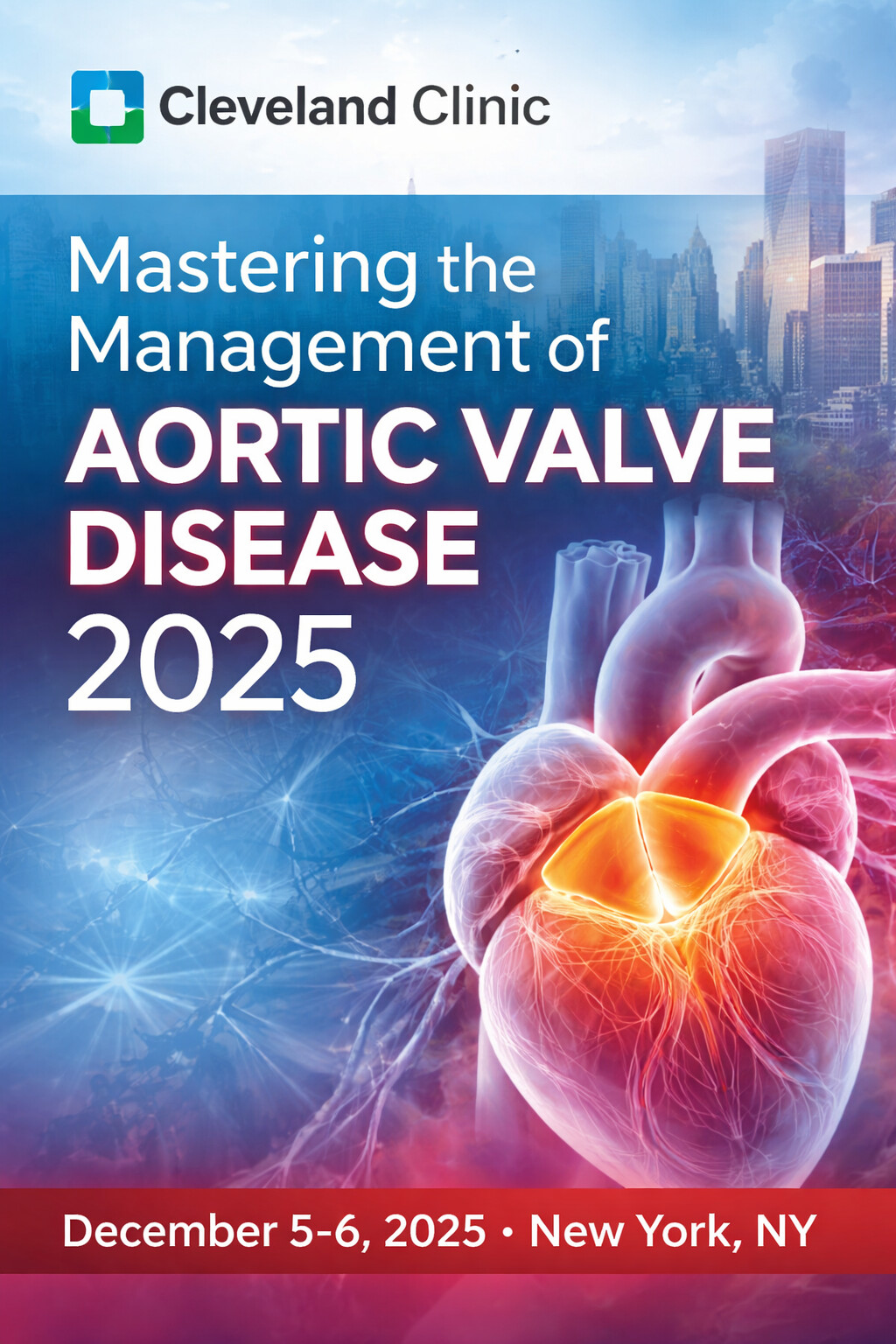
The management of patients with aortic valve disease is constantly evolving, highlighted by innovations in devices, surgical techniques and imaging. In addition, research studies and clinical trials are continually expanding the evidence base related to management decisions and interventions. This educational activity will offer a comprehensive platform for healthcare professionals to explore the latest evidence-based practices, procedural techniques, and collaborative strategies critical for managing patients with aortic valve disease.
Who Should Attend?
This course is intended for cardiologists, cardiology fellows, cardiothoracic surgeons, internists, nurses, physician assistants, and all health care professionals involved in the evaluation, diagnosis and/or management of patients with aortic valve disease.
Learning Objectives
- Evaluate the clinical presentation and management strategies for patients with aortic valve disease by incorporating patient-specific considerations, timing of intervention and risk stratification.
- Analyze the strengths and limitations of various imaging modalities for diagnosing and guiding the treatment of aortic valve disease.
- Describe the current state-of-the-art and emerging therapeutic options for aortic valve disease, emphasizing evidence-based and patient-centered care.
- Incorporate interprofessional approaches to optimize outcomes for patients undergoing transcatheter and surgical interventions.
- Navigate the management and ethical dilemmas in the management of elderly and medically complex patients with aortic valve disease
| S. No. | Title | Duration |
|---|---|---|
| 1 | Aortic Valve Repair & Root Reimplantation | 16:03 |
| 2 | Importance of Prosthesis-Patient Mismatch after TAVR: Definitions, Incidence and Clinical Relevance | 09:18 |
| 3 | Planning for Successful Valve-in-Valve / TAV-in-TAV | 13:56 |
| 4 | Cerebral Embolic Protection During TAVR: What Does Data Support? | 08:16 |
| 5 | Optimal Antithrombotic Therapies Post-TAVR: Updates and Controversies | 12:50 |
| 6 | Management of Hemodynamic Collapse During TAVR | 11:51 |
| 7 | Management of Paravalvular Leaks After SAVR and TAVR | 08:42 |
| 8 | Interventional Techniques and Trials: Preemptive TAVR & Device Durability | 11:14 |
| 9 | Aortic Valve Durability: 5- and 7-Year Results From the COMMENCE Trial | 05:40 |
| 10 | Predictors of Pacemaker Dependency | 10:27 |
| 11 | Case Presentation: Cardiogenic Shock Presenting to CICU | 06:53 |
| 12 | Acute Valvular Emergencies: Assessment and Stabilization in Cardiogenic Shock | 06:36 |
| 13 | Aortic Valve Interventions in Patients in Cardiogenic Shock | 12:09 |
| 14 | Aortic Stenosis and Cardiogenic Shock | 05:24 |
| 15 | Case Presentation: Radiation Heart Disease with Aortic Valve Involvement | 05:50 |
| 16 | Radiation Associated Cardiovascular Disease: Diagnosis and Management | 10:16 |
| 17 | TAVR for Patients with Prior Radiation Therapy | 09:34 |
| 18 | Aortic Valve Disease Associated with Radiation: Surgical Options | 09:03 |
| 19 | Case Presentation: Young Patient With Connective Tissue Disorder (Marfan’s vs LDS) | 06:13 |
| 20 | Screening and Managing High-Risk Patients With Hereditable Thoracic Aortic Disease | 11:49 |
| 21 | Surgical Management of the Aortic Root | 12:19 |
| 22 | Our Most Important Contributions to TAVR from Cleveland Clinic: 2025 | 09:50 |
| 23 | Case Presentation: Patient With Severe Aortic Insufficiency | 06:04 |
| 24 | Aortic Regurgitation: Multimodality Imaging Work-Up and Guidelines | 10:34 |
| 25 | Treatment of Aortic Insufficiency Using TAVR Systems: Current Landscape in 2025 | 10:30 |
| 26 | Most Important TAVR Papers 2024–2025 | 11:50 |
| 27 | The Most Important Surgical CCF Papers | 15:24 |
| 28 | Clinical Information and Management: Beyond the Index Procedure | 10:59 |
| 29 | Medical Therapy for Aortic Stenosis: Emerging Evidence and Practice | 09:46 |
| 30 | Managing Heart Failure in Aortic Stenosis With Multivalve Disease | 11:33 |
| 31 | Aortic Stenosis and Heart Failure | 09:43 |
| 32 | Imaging Cardiologist: Multimodality Imaging in Decision Making | 14:18 |
| 33 | Benefit of Surgical Intervention in Low Flow, Low Gradient Severe AS | 02:06 |
| 34 | Case Presentation: Aortic Valve Endocarditis | 05:05 |
| 35 | Clinical/Imaging Cardiologist: Role of Multimodality Imaging | 10:28 |
| 36 | Critical Care Management in Aortic Endocarditis | 08:26 |
| 37 | Aortic Valve Endocarditis: Surgical Options | 08:48 |
| 38 | Case Presentation: Low Risk Aortic Stenosis | 05:33 |
| 39 | Case Presentation: Low Flow Low Gradient Aortic Stenosis | 06:46 |
| 40 | Case Presentation: Stenotic Bicuspid Aortic Valve in an Octogenarian | 06:41 |
| 41 | Aortic Stenosis in an Octogenarian: Frailty, Imaging, Futility | 10:46 |
| 42 | Association of BAV Anatomy With TAVR Outcomes | 10:05 |
| 43 | Surgeon: Role of Surgery and Contemporary Outcomes | 04:10 |
| 44 | Assessing Flow Reserve, Aortic Calcium Score, Team-Based Care | 12:02 |
| 45 | TAVR for Low-Flow, Low-Gradient Severe AS: State-of-the-Art Review | 11:01 |
| 46 | Surgical Role: Current Data to Justify SAVR | 14:04 |
| 47 | Interventional Role: Data Supporting Low-Risk TAVR Trials | 09:53 |
| 48 | Contemporary Trends in Aortic Valve Disease Management | 10:39 |
| 49 | Sex Differences in Aortic Valve Disease: Why Should We Care? | 12:11 |
| 50 | Evaluation of Procedural Risk: Shared Decision Making | 25:26 |

Reviews
There are no reviews yet.